7 questions every charity trustee should be asking before the end of the year

Being a charity trustee has never been straightforward.
You're expected to oversee finances, manage risk, support the leadership team, ensure good governance, comply with regulations and help steer the organisation towards its mission. Most trustees do all of this voluntarily, alongside demanding careers, family commitments and countless other responsibilities.
At the same time, the challenges facing charities continue to grow. Rising costs, increasing demand for services, ongoing funding pressures and a changing regulatory landscape mean many boards are having to make difficult decisions.
If that sounds familiar, you're not alone.
Over the years, we've worked alongside charities of all shapes and sizes. We've sat in board meetings, supported trustees through periods of growth and helped organisations navigate uncertainty. The conversations are often remarkably similar. Trustees want to do the right thing, but they don't always have all the information, confidence or expertise they feel they need to make the best decisions.
The good news is that trustees don't need to have all the answers. They do, however, need to be asking the right questions.
Here are seven questions every charity trustee should be asking before the end of the year.
1. Do we really understand our financial position?
Most trustees receive financial information at board meetings. The important question is whether everyone around the table genuinely understands what that information is telling them.
Can you clearly answer:
- How much unrestricted funding do we have available?
- Are we performing in line with budget?
- Are there any emerging financial concerns?
- What are the biggest financial risks facing the organisation?
Trustees shouldn't feel uncomfortable asking questions if something isn't clear. In fact, asking those questions is part of the role.
A healthy board culture is one where trustees feel confident saying, "Can you explain that another way?" or "What does this mean for the charity over the next 12 months?"
2. How resilient are we if circumstances change?
Many charities are operating in an environment that feels increasingly unpredictable.
A major donor could reduce their support. A grant programme could end. Demand for services could increase unexpectedly. Costs could rise faster than anticipated.
Trustees should know how well prepared their organisation would be if one of these scenarios became reality.
Consider:
- How dependent are we on a small number of funding sources?
- What would happen if a key income stream disappeared?
- Do we have sufficient reserves?
- Have we discussed potential risks and contingency plans?
Resilience isn't about expecting the worst. It's about making sure the charity is prepared if circumstances change.
3. Are we receiving the information we need to make good decisions?
Board papers are often lengthy. Trustees can find themselves reviewing dozens of pages before every meeting.
But more information doesn't always lead to better decisions.
The best trustee boards receive information that is clear, relevant and focused on what matters most.
Ask yourself:
- Are we receiving meaningful management information?
- Do reports focus on key risks and opportunities?
- Can trustees quickly identify areas requiring attention?
- Are we spending enough time discussing strategy rather than simply reviewing reports?
Trustees should leave meetings feeling informed and confident, not overwhelmed.
4. Is our governance keeping pace with our organisation?
As charities grow and evolve, governance arrangements need to evolve too.
Processes that worked perfectly when the organisation was smaller may no longer be appropriate.
This might include:
- Reviewing trustee skills and experience
- Succession planning
- Updating policies and procedures
- Reviewing delegated authorities
- Assessing board effectiveness
Good governance rarely becomes a problem overnight. More often, challenges emerge gradually as organisations grow faster than their governance framework.
Regular reviews help ensure your board remains fit for purpose.
5. Are we confident we're meeting our regulatory responsibilities?
Few trustees join a board because they enjoy regulation and compliance.
Yet trustees carry significant responsibility for ensuring their charity meets its legal and regulatory obligations.
That doesn't mean every trustee needs to be a technical expert.
It does mean the board should have confidence that key responsibilities are being properly managed and monitored.
Trustees should feel comfortable asking:
- Are we meeting our reporting requirements?
- Are we up to date with any regulatory changes?
- Do we have appropriate financial controls in place?
- Have we identified any areas of concern?
Seeking advice when needed isn't a sign of weakness. It's good governance.
6. Do we understand the financial impact of our strategic decisions?
Every strategic decision has financial consequences.
Opening a new location. Launching a new service. Investing in technology. Expanding a fundraising programme.
These can all be positive opportunities, but trustees need to understand both the ambition and the financial reality.
Before making significant decisions, boards should ask:
- Can we afford this?
- Have we modelled different scenarios?
- What happens if income doesn't grow as expected?
- How will success be measured?
The strongest boards balance enthusiasm with careful challenge.
7. Are we giving ourselves enough time to think about the future?
Many trustee meetings are dominated by immediate issues.
Budgets. Reports. Risks. Operational updates.
All of these are important, but trustees also have a responsibility to look ahead.
Questions worth discussing include:
- What will the charity need from us over the next three to five years?
- What challenges are emerging in our sector?
- Are we investing in long-term sustainability?
- What opportunities could help us increase our impact?
Creating space for these conversations can be difficult, but it is often where trustees add the greatest value.
You don't have to navigate these challenges alone
Every trustee wants the same thing: to ensure their charity can continue making a meaningful difference.
The reality is that many of the issues trustees face today are complex. Financial reporting, governance, risk, reserves, funding pressures and compliance requirements can feel daunting, particularly when you're balancing trustee responsibilities with everything else in your life.
That's why having the right support matters.
At Rickard Luckin, we work with charities and not-for-profit organisations every day. We understand the challenges trustees face because we've helped boards navigate them time and time again. We know the pressures, the responsibilities and the difficult decisions that come with stewardship of a charity.
Most importantly, we believe trustees shouldn't have to tackle those challenges alone.
Trustees don't need to become accountants, but they do need confidence in the financial and governance information they're reviewing.
Our Not-for-Profit Know How programme is designed to help charity trustees and leaders understand the issues that matter most through practical, jargon-free sessions delivered by our charity specialists.
Register for our next Not-for-Profit Know How event to receive practical insights, build confidence and connect with others facing similar challenges.
Together. We've got this.
If you have any questions about the above, or would like more information specific to your circumstances, please enter your email address below and we will get in touch:
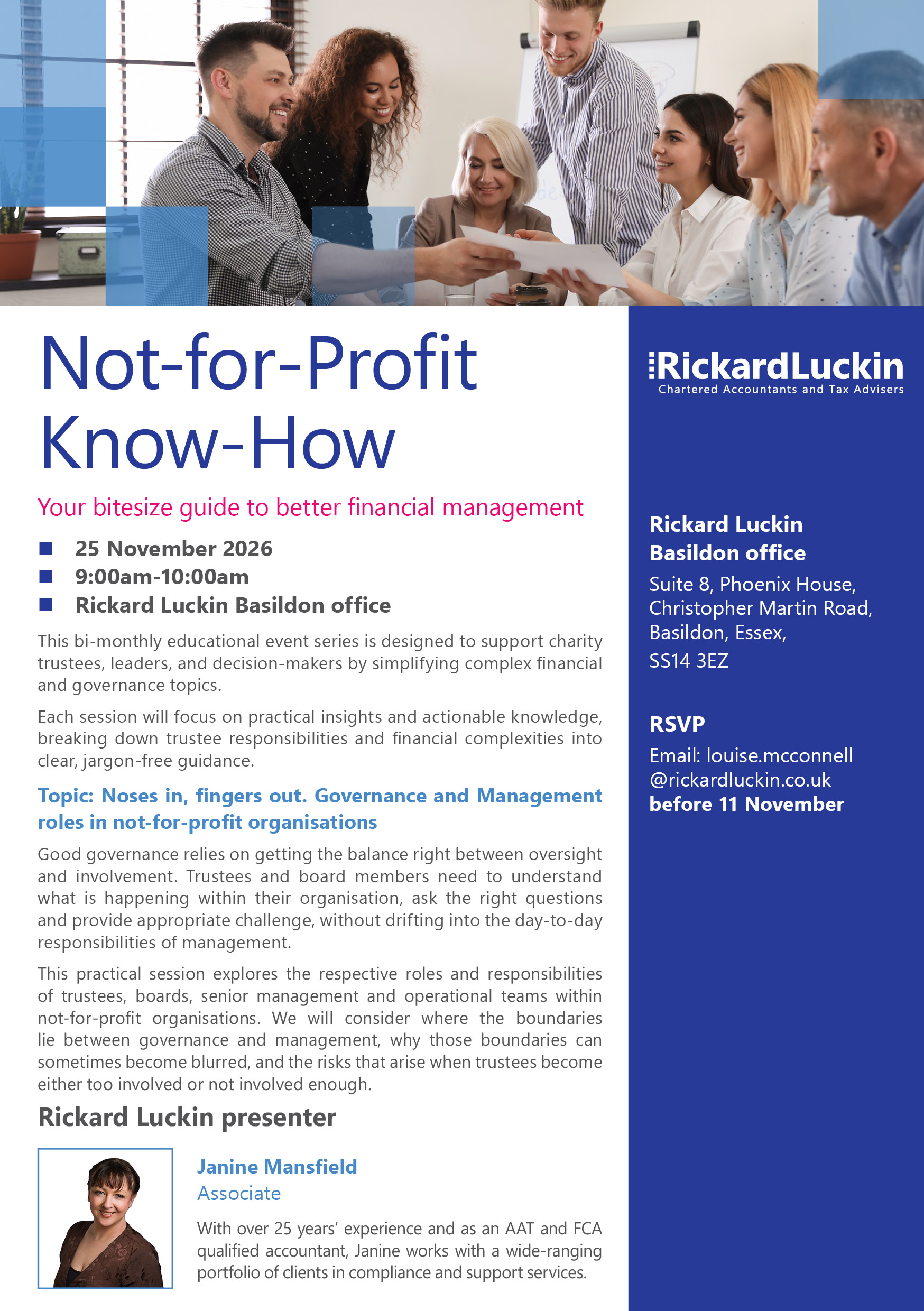
Noses in, fingers out. Governance and Management roles in not-for-profit organisations
This bi-monthly educational event series is designed to support charity trustees, leaders, and decision-makers by simplifying complex financial and governance topics. Register your interest by emailing [email protected]
Spaces are limited.


Related View All



Our Accreditations and Memberships